
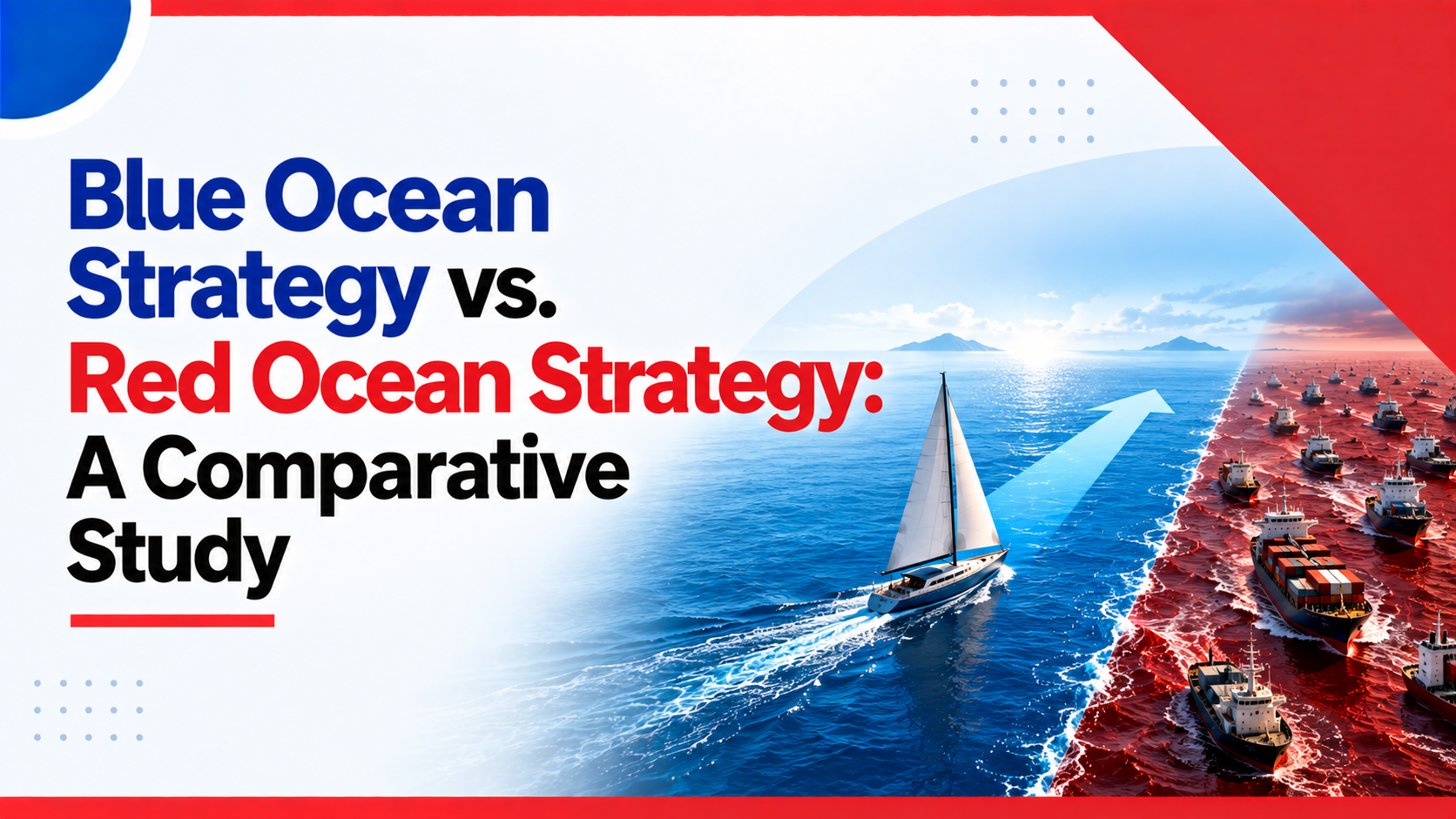
Meaning of Blue Ocean Strategy
This concept was introduced by W. Chan Kim and Renee Mauborgne in their book Blue Ocean Strategy. In this strategy, a new and uncontested marketspace is created where there’s no competition. Organizations don’t have to compete with existing businesses. Instead, they focus on innovation, customer value, and creating new demand.
In a blue ocean, businesses develop unique products or services that solve the problems of their target customers in a different way. Since, there is no competition in the initial times, businesses can make higher profits and establish a strong position in the market.
Key Features of Blue Ocean
- Creates a new market space.
- Competition becomes irrelevant.
- Focuses on innovation and creating value.
- Generates new customer demand.
- Provides opportunities for high growth and profitability.
- Encourages to be unique with low cost.
- Supports long-term business sustainability.
Principles of Blue Ocean Strategy
This strategy is based on several important principles:
1. Rebuilding Market Boundaries
Organizations should look for new opportunities by looking beyond existing industry boundaries. They should look for new different industries. They should explore different industries, customer groups, technologies, business models to discover markets that aren’t yet known much and create innovative solutions.
2. Focus on the Big Picture
Managers should concentrate on strategic planning that works in the long-term rather than short-term competition. This helps businesses achieve sustainable growth, improve decision-making, and maintain a stong competitive position in the future.
3. Reach Beyond Existing Demand
Rather than serving only existing customers, businesses should attract non-customers. They should create new demand and attract new customers. By understanding the needs of potential buyers, businesses expand their customer base and increase market opportunities.
4. Get the Strategic Sequence Right
Businesses should ensure that innovation creates value for customers while generating enough profits. Products should offer high utility, affordable pricing, manageable costs, and successful implementation for long-term success.
5. Overcome Organizational Hurdles
Organizations should take measures to remove internal barriers that prevent change and innovation. With employee motivation, effective leadership, proper communication, and resource allocation, they can implement new strategies successfully.
6. Build Execution Into Strategy
Employees at every level should understand and support the implementation of the strategy. Clear communication, teamwork, continuous learning, and regular performance monitoring help successful of strategic plans.
Four Actions Framework of Blue Ocean Strategy
One of the most important tools of Blue Ocean Strategy is the Four Actions Framework. It helps companies create value and innovation.
- Eliminate – Remove factors that the industry has long competed on but no longer provide value.
- Reduce – Minimize factors or features below industry standards to reduce costs.
- Raise – Increase factors that customers value more than current industry standards.
- Create – Introduce entirely new features or services that competitors have never offered.
Using this framework, organizations can develop new and advanced products while reducing unnecessary costs.
Value Innovation
It is the foundation of Blue Ocean Strategy, which creates higher value for customers while simultaneously reducing costs. Businesses don’t have to choose between low cost differentiation, but they can achieve both together.
Benefits of Value Innovation
- Creates unique products.
- Reduces unnecessary expenses.
- Attracts new customers
- Improves customer satisfaction
- Generates sustainable competitive advantage
- Increases long-term profitability.
Strategy Canvas
This is an analytical tool used in blue ocean strategy. It helps organizations compare their products with competitors based on different competitive factors.
Importance of Strategy Canvas
- Identifies market opportunities
- Shows strengths and weaknesses
- Helps in strategic decision-making.
- Supports value innovation
- Highlights areas for innovation.
Advantages of Blue Ocean Strategy
- Less competition
- Higher profit margins
- Creates new customer demand
- Encourages creativity and innovation
- Strong brand differentiation
- Better customer satisfaction
- Long-term competitive advantage
- Sustainable business growth.
Disadvantages of Blue Ocean Strategy
- High research and development costs
- Risk of market uncertainty.
- Success is difficult to predict.
- Requires continuous innovation
- Competitors may eventually enter the market
- Needs skilled leadership and strategic planning.
Blue Ocean Strategy Examples
There are some well-known organizations that have successfully created blue oceans by introducing innovative products or business models.
- Apple Inc.
The company transformed the entire smartphone market by combining communication, entertainment, and internet services into a single user-friendly device, creating exceptional customer value.
- NetFlix
This brand shifted from DVD rentals to online streaming, creating a new entertainment market and changing how people watch movies and television.
Meaning of Red Ocean Strategy
It refers to competing in an existing market where many businesses offer similar products or services. Businesses compete with each other on the basis of price, quality, customer service, or advertising to gain a larger market share. The term “red ocean” indicates intense competition where the market becomes crowded, which makes it difficult to earn high profits.
Businesses that use this strategy mainly focus on attracting customers from competitors instead of creating new markets. They work towards improving their products or services continuously, reduce costs, and use promotional activities to stay competitive. Most traditional industries such as banking, automobiles, retail, and telecommunication operate in red ocean markets.
In red oceans, organizations focus more on outperforming competitors rather than creating new demand.
Key Features of Red Ocean Strategy
- Competes in an existing market
- High level of competition
- Focuses on beating competitors
- Existing customer demand is targeted
- Price competition is common
- Profit margins are generally lower
- Market boundaries are well defined.
Characteristics of Red Ocean Strategy
The following characteristics are commonly found in Red Ocean Strategy:
- Existing market boundaries
- Instense rivalry among competitors
- Price-based competition
- Incremental product improvements
- Limited innovation
- High marketing expenditure.
- Customer retention becomes a major challenge.
- Lower profit margins due to competition.
Advantages of Red Ocean Strategy
- Existing customer base
- Easier market analysis
- Predictable customer demand
- Lower market uncertainty.
- Established distribution channels.
- Faster implementation
- Proven business models
Disadvantages of Red Ocean Strategy
- Intense competition
- Lower profit margins
- Frequent price wars
- High advertising costs
- Limited innovation
- Slow business growth
- Difficulty in customer retention
Red Ocean Strategy Examples
Many industries operate under Red Ocean Strategy because numerous competitors sell similar products.
- Coca-Cola Vs PepsiCo
Both companies continue to compete through pricing, advertising, product variations, and promotional campaigns.
- Samsumg Electronics Vs Xiaomi
These companies compete in existing smartphone markets through product features, pricing, and marketing strategies.
Blue Ocean Strategy Vs Red Ocean Strategy
| Basis of Difference | Blue Ocean Strategy | Red Ocean Strategy |
| Meaning | Creates a new market space | Compete in an existing market space |
| Competition | Very low or no direct competition | Intense Competition |
| Market | Uncontested market | Existing and crowded market |
| Focus | Innovation and value creation | Beating competitors |
| Customer Demand | Creates new demand | Serving existing demand |
| Pricing | Value-based | Competitive |
| Cost Strategy | Achieves differentiation with low cost | Often higher cost due to competition |
| Profitability | Higher profit potential | Lower profit margins |
| Innovation | High level of innovation | Limited or incremental innovation |
| Growth | Higher growth opportunities | Moderate growth |
| Risk | Higher uncertainty in the beginning | Lower uncertainty but intense rivalry |
| Marketing | Focuses on educating and attracting new customers | Focuses on capturing competitors’ customers |
| Business objective | Create unconstested market space | Gain larger market share |
| Long-term Sustainability | More sustainable through innovation | Difficult due to continuous innovation |
| Examples | Apple, NetFlix | Coca Cola Vs PepsiCo. , Samsumg Vs Xiaomi |