
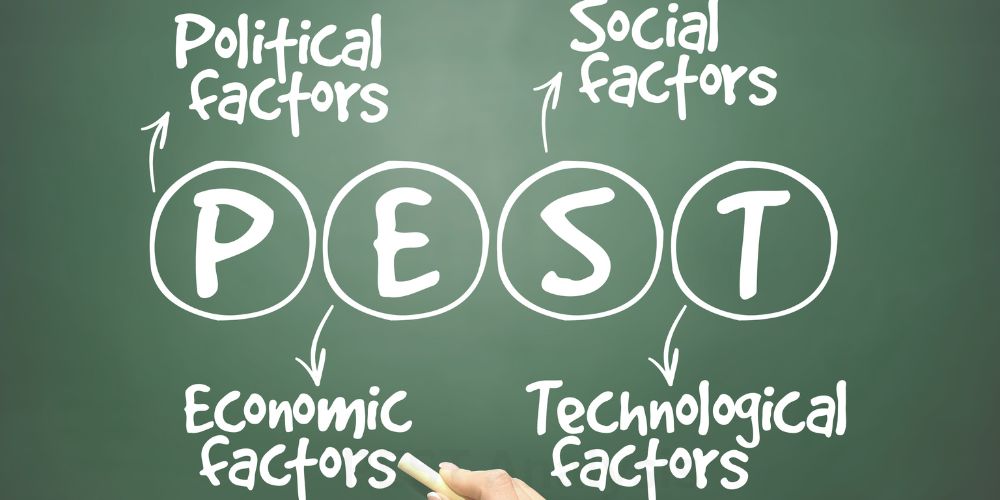
Businesses do not operate in isolation. Even if a company has strong products, a skilled team, and healthy finances, its strategy can still be shaped by forces outside its control, such as policy changes, inflation, social shifts, or new technology.
That is where PEST analysis becomes useful. It helps decision-makers scan the broader external environment before making strategic choices about growth, pricing, expansion, risk, hiring, or investment.
What Is PEST Analysis?
PEST analysis is a strategic management framework used to examine four major external forces that can affect an organization:
- Political
- Economic
- Social
- Technological
The goal is simple: understand the macro-environment around the business before making important decisions.
A common variation is PESTLE, which adds Legal and Environmental factors. Both versions are used to understand how outside trends and disruptions can influence strategy, performance, and risk. Source
Why PEST Analysis Matters
PEST analysis matters because many of the biggest business risks and opportunities begin outside the company.
A firm may have no control over interest rates, tax rules, regulation, demographics, or technology adoption speed. But it can still prepare for them. That is what makes PEST analysis valuable in strategic planning, market entry, product launches, and expansion decisions.
For example, IMF forecasts show that changes in global growth expectations can influence investment conditions, consumer demand, and business confidence across industries and countries. In its January 2026 update, the IMF projected global growth at 3.3% for 2026 and 3.2% for 2027. Source
What Does PEST Stand For?
1. Political Factors
Political factors refer to how government actions and public policy affect business conditions.
These may include:
- Taxation
- Trade policy
- Labor laws
- Industry regulation
- Tariffs
- Political stability
- Government incentives
- Public spending priorities
A stable policy environment can support business planning. Sudden changes in regulation, taxation, or trade rules can increase uncertainty and operating costs.
Example: In India, the Goods and Services Tax Council oversees GST laws, rates, and notifications. Changes in indirect tax rules can affect compliance, supply chains, pricing, and working capital for businesses across sectors. Source
2. Economic Factors
Economic factors shape purchasing power, borrowing costs, margins, and expansion plans.
These may include:
- Inflation
- Interest rates
- Exchange rates
- Unemployment
- GDP growth
- Wage levels
- Consumer confidence
When inflation rises or borrowing becomes expensive, consumers and businesses often reduce spending. When growth strengthens, companies may invest more aggressively in hiring, production, and expansion.
Example: IMF growth and inflation outlooks are closely watched because they affect investment sentiment, credit conditions, and consumer demand worldwide. The IMF’s October 2025 outlook projected global growth of 3.2% in 2025 and 3.1% in 2026, while its January 2026 update revised 2026 growth to 3.3%. October 2025 outlook | January 2026 update
3. Social Factors
Social factors focus on people: how they live, work, buy, and think.
These may include:
- Demographics
- Education levels
- Lifestyle changes
- Cultural attitudes
- Health awareness
- Consumer preferences
- Population growth
- Workforce expectations
Social trends are important because they often shape demand. A company may have the right product technically, but still struggle if it does not match changing customer values or habits.
Example: Rising interest in health, sustainability, and ingredient transparency has increased demand for plant-based and lower-impact food products, pushing consumer brands to adapt product portfolios and messaging. This is a classic social trend affecting strategy.
4. Technological Factors
Technological factors refer to innovation and the pace of change in tools, systems, and infrastructure.
These may include:
- Automation
- Artificial intelligence
- Digital payments
- Cybersecurity
- Research and development activity
- Internet penetration
- Cloud computing
- Manufacturing technology
Technology can improve efficiency, lower costs, and create new business models. It can also make old models obsolete quickly.
Example: The rapid adoption of AI tools, automation platforms, and digital customer-service systems has changed expectations around speed, personalization, and cost efficiency in many industries. Businesses that fail to adapt often lose ground to faster competitors.
How to Do a PEST Analysis
A PEST analysis works best when it is practical, specific, and tied to a real business decision.
Step 1: Define the Objective
Start by deciding why you are doing the analysis.
Common objectives include:
- Entering a new market
- Launching a new product
- Expanding internationally
- Reviewing long-term strategy
- Assessing external risk
- Evaluating investment opportunities
Without a clear objective, the analysis becomes a generic list instead of a useful planning tool.
Step 2: Gather External Information
Collect relevant information for each PEST category.
Use a mix of:
- Government publications
- Central bank or IMF data
- Industry reports
- Market research
- Competitor signals
- Credible news sources
- Customer and demographic data
The quality of a PEST analysis depends on the quality of the inputs.
Step 3: Identify the Most Relevant Factors
Do not list everything. Focus on the external factors most likely to affect your business or decision.
For example:
- A retailer may care deeply about inflation, consumer confidence, and digital payment adoption
- A manufacturer may focus more on tariffs, energy prices, labor rules, and automation
- A university may look more closely at student demographics, public funding, and AI in education
Step 4: Analyze Impact
For each factor, ask:
- Is this a risk, an opportunity, or both?
- How likely is it to change?
- How big is the impact?
- Is it short term or long term?
- Can the business prepare for it?
This turns raw observation into strategic insight.
Step 5: Turn Findings Into Action
A good PEST analysis should lead to decisions.
Examples:
- Change pricing strategy
- Delay market entry
- Invest in new technology
- Diversify suppliers
- Redesign products
- Strengthen compliance planning
- Target a new customer segment
If the analysis does not influence action, it is incomplete.
PEST Analysis Example: Tesla
A simple way to understand the framework is to apply it to a real company.
Political
Electric vehicle demand is affected by subsidies, emissions policy, trade rules, and industrial policy. Government incentives in the U.S. and Europe can support EV adoption, while tariffs and trade tensions can raise supply-chain costs.
Economic
Tesla’s performance can be influenced by interest rates, consumer financing conditions, disposable income, and raw-material prices. When borrowing becomes expensive, vehicle affordability becomes a bigger issue.
Social
Growing public awareness of climate change and environmental impact has helped make electric vehicles more attractive to many buyers. Consumer attitudes toward sustainability and innovation support EV demand.
Technological
Tesla competes heavily through battery performance, software, autonomous-driving systems, manufacturing efficiency, and over-the-air updates. Rapid innovation is both an advantage and a pressure point because competitors are investing aggressively too.
This example shows why PEST analysis is useful: it helps explain how a company’s future is shaped not only by its internal capabilities, but also by the environment around it.
Benefits of PEST Analysis
PEST analysis is useful because it helps organizations look beyond day-to-day operations.
1. Improves Strategic Awareness
It forces leaders to step back and consider broader changes that may affect the business.
2. Supports Better Long-Term Planning
It helps companies prepare for future shifts instead of reacting too late.
3. Highlights Risks Early
Policy changes, inflation pressure, social shifts, and technology disruption often become visible before they fully hit performance.
4. Reveals Opportunities
External change is not always negative. It can uncover growth areas, new customer needs, or market gaps.
5. Strengthens Decision-Making
A strategy backed by macro-environment analysis is usually stronger than one built only on internal assumptions.
Limitations of PEST Analysis
PEST analysis is helpful, but it is not enough on its own.
1. It Does Not Predict Sudden Shocks
Frameworks can highlight trends, but they cannot fully predict events such as pandemics, wars, or abrupt policy reversals.
2. It Can Become Too Broad
If the analysis covers everything, it may say very little that is useful.
3. It Depends on Judgment
Different teams may interpret the same external trend differently.
4. It Needs Regular Updates
External conditions change quickly. An outdated PEST analysis can be misleading.
5. It Should Be Combined With Other Tools
PEST explains the macro environment, but it does not replace tools that assess competition, capabilities, or internal weaknesses.
PEST vs SWOT: What Is the Difference?
| Feature | PEST Analysis | SWOT Analysis |
|---|---|---|
| Main focus | External macro-environment | Internal and external factors |
| Looks at | Political, economic, social, technological forces | Strengths, weaknesses, opportunities, threats |
| Best used for | Market scanning, long-term planning, expansion decisions | Strategy development and competitive positioning |
| Main question | What external forces could affect us? | How do our internal strengths and weaknesses compare with external opportunities and threats? |
In practice, many organizations use both. PEST helps identify the broader environment, while SWOT helps connect that environment to the organization’s internal situation. Source
When Should Businesses Use PEST Analysis?
PEST analysis is especially useful when a business is:
- Entering a new market
- Launching a new product
- Planning expansion
- Reviewing long-term strategy
- Evaluating investment risk
- Preparing for regulation changes
- Facing technological disruption
It is also useful during annual or semiannual strategy reviews. In volatile environments, more frequent updates may be necessary.
Who Should Use PEST Analysis?
PEST analysis is not just for large corporations.
It can be useful for:
- Startups
- Small and medium businesses
- Multinational companies
- Consultants
- Non-profits
- Public sector institutions
- Students studying business strategy
- Professionals thinking about industry trends and career planning
The framework is simple enough to learn quickly, but flexible enough to apply across industries.
PEST or PESTLE: Which Should You Use?
Use PEST when you want a simple macro-environment scan and the four core categories cover the main issues.
Use PESTLE when legal and environmental issues need separate attention. This is often the case in industries such as healthcare, energy, manufacturing, education, transport, and financial services.
There is no single better version. The best choice depends on how detailed the decision requires the analysis to be.
Final Thoughts
PEST analysis is one of the simplest and most useful tools for understanding the world around a business.
It does not tell managers exactly what to do. What it does do is improve the quality of strategic thinking by making external forces visible before they become urgent problems.
That is why the framework remains useful. Political changes can reshape compliance. Economic shifts can alter demand. Social trends can move customer preferences. Technology can change how industries compete.
Businesses that pay attention to those signals usually make better decisions than those that focus only on internal strengths.
Frequently Asked Questions
What Is PEST Analysis in Simple Words?
PEST analysis is a framework used to study external factors that affect a business: political, economic, social, and technological factors.
What Is the Main Purpose of PEST Analysis?
Its main purpose is to help organizations understand the external environment before making strategic decisions.
What Is the Difference Between PEST and PESTLE?
PEST covers political, economic, social, and technological factors. PESTLE adds legal and environmental factors.
Is PEST Analysis Qualitative or Quantitative?
It is mainly qualitative, but it often uses quantitative inputs such as inflation, GDP growth, or demographic data.
How Often Should a PEST Analysis Be Updated?
Many organizations review it once or twice a year. In unstable conditions, quarterly updates may be more useful.
Can Individuals Use PEST Analysis?
Yes. Professionals can use it to evaluate career trends, industry changes, technology shifts, and job-market conditions.
References
- Investopedia — What Is PEST Analysis?
- IMF — World Economic Outlook Update, January 2026
- IMF — World Economic Outlook, October 2025
- IMF DataMapper — World Real GDP Growth
- GST Council of India — Official Website

- Everything you should know about the Case study - October 3, 2026
- Top Ten Online Data Analytics Courses in the USA - October 2, 2026
- Different Types of Organizational Structures with Examples - September 30, 2026